Tripods are an essential tool for photography. Every photographer, at one point or another, will have to purchase one. Like many photographic purchases (like the batteries I just bought), tripods are not a particularly glamorous purchase. Despite this, getting one which suits your needs is essential. Most decent tripods are made up of at least two main parts: the legs / sticks, and the head. In this article, I’ll be covering the tripod head and its many, many variations.
Tripod heads come in many forms and, arguably, are the most important part of the tripod. So long as you’re not going for some dirt cheap legs, most will be adequate for the majority of requirements. The tripod head, on the other hand, has many features which benefit different types of photography.
Tripod Heads: At a Glance
This guide covers the five main types of tripod heads and helps you determine which is best for your photography style.
- The Ball Head – Fast, versatile, and ideal for general photography
- The Pan and Tilt Head – More precision than ball heads with separate axis controls
- The Geared Head – Ultimate precision for product and architectural photography
- The Gimbal Head – Built for heavy telephoto lenses and wildlife work
- The Pistol Head – Ball head variant with one-handed grip control
- Frequently Asked Questions – Common tripod head questions answered
- Summary and What Head Is Right For Me? – Final recommendations
The Ball Head

Pros:
Speed is the ball head’s greatest strength. The main knob can be quickly loosened and tightened for fast adjustments to camera position. With a good ball head you’ll also be able to use varying degrees of tension, which will allow you to move the camera without always needing to fully loosen and tighten the head. This tension control becomes invaluable when you’re tracking a moving subject or need to make quick compositional changes between shots.
Versatility is the reason ball heads are so common among photographers. For any photography which does not require pinpoint accuracy, a ball head can be very useful. If your subject is moving then you can simply loosen the knob and freely move the camera in any direction you want, while still reaping some of the benefits of being on a tripod. If you then find a shot that needs a locked off position, you can quickly tighten the head. I’ve used a ball head for portraits, headshots, family photography, wildlife, and product photography (in a pinch).
Cons:
Precision can be a challenge with ball heads. If precise movements with small adjustments will be necessary, a ball head may not suit your needs. While lots of the more expensive heads will not sag very much after you tighten the head, many do. This slight movement that occurs as you lock down the ball can throw off a carefully composed frame. As a result, ball heads are not generally the choice of product or interior photographers who need their compositions exact to the millimeter.
Weight bearing can be a concern depending on your gear. For the majority of circumstances this won’t be an issue, especially if you purchase something expensive like the BH-55 pictured above by Really Right Stuff. That’s a tripod head I have drooled over for some time. However, if your budget won’t stretch that far then you may run into issues when using heavier kit at more extreme angles. Ball heads can take a lot of weight but if they’re not good quality, you may get some movement at particular angles with heavy lenses.
The Pan And Tilt Head

Pros:
More precision is the defining characteristic of pan and tilt heads. I would say these are the next most common type of tripod head after ball heads. Rather than only having one main knob which controls most movement (like the ball head), pan and tilt heads have separate arms which allow the user to adjust the pan and tilt separately. This independent axis control means you can fine-tune your horizontal framing without affecting your vertical angle, and vice versa.
They can take more weight (generally), compared to ball heads, and especially at the extreme angles mentioned above. The mechanical design distributes force more evenly across the locking mechanisms, which makes them better suited for heavier camera and lens combinations.
Cons:
Bulky is perhaps the most common complaint. Some versions have arms which retract thereby reducing their size for transportation, but most don’t. With the arms out, a pan and tilt head can become quite cumbersome and awkward to pack in a camera bag.
Lack of precision (compared to geared heads) is worth noting. While they are more precise than a ball head they’re not the epitome of accuracy. To adjust a pan and tilt head, you loosen the handle, adjust and then tighten again. By the very nature of having to loosen and then tighten again, there will be some movement. So while it is far more accurate when compared to a ball head, they pale in comparison to geared heads.
Slow operation is another drawback. If speed is required, a pan and tilt head is not for you. Having to manipulate multiple handles to reposition your camera takes considerably more time than a single ball head knob.
Generally speaking, the pan and tilt head is a compromise between a ball head and a geared head. It hasn’t got the speed or versatility that a ball head provides, nor the precision of a geared head. A jack of all trades, master of none, if you will. For that reason, I have never been much of a fan.
The head pictured above is the Manfrotto MHXPRO-3W, you can find it here.
The Geared Head
Pros:
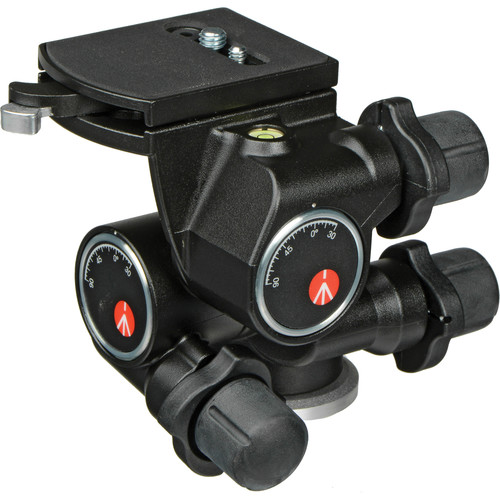
Ultimate in precision is what geared heads deliver. I own the Manfrotto 410 Junior pictured above, and absolutely love it. For many people it won’t be necessary, but for any photographer that needs precision from their tripod head, a geared head is heaven. No longer do you perfectly frame your shot, tighten the head and watch as the camera moves slightly! With a geared head, you never need to loosen the adjustment knobs. Instead, you twist them and the camera slowly moves. Let go, and your frame will stay exactly where you left it. This makes them ideal for product photography, architectural work, and any situation where exact framing is critical.
Weight at angles is another strength. Because of the way geared heads are designed, they will not move at those extreme angles I have been mentioning. They normally aren’t rated to bear as much weight as other types of heads but once locked in, they will stay there without any drift or sag.
Cons:
Slow operation is inherent to the design. As you can imagine, turning knobs to move the camera can be very slow. There’s usually a feature to fully loosen each knob but geared heads can never match a ball head for speed. However, if precision is what you need, then a geared head will speed you up significantly in the long run because you won’t waste time trying to lock in a composition that keeps shifting. That’s a fine but important distinction.
Bulky and heavy is the trade-off for that precision. Just like pan and tilt heads, these are bulky and heavy; in my experience, heavier than pan and tilt heads. Although, if you are using one of these I imagine you won’t be moving too much anyway.
I haven’t used every tripod head under the sun and never recommend things I don’t have direct experience with. If you’re in the market for a geared head, I can, however, fully recommend the Manfrotto 410 Junior. It’s a good compromise between price and performance. Find it here.
The Gimbal Head

Pros:
Can support a lot of weight, which is the primary reason gimbal heads exist. Gimbal heads are mostly used by photographers with BIG lenses, think sports and wildlife. They make using large lenses comfortable and fast. Using a BIG lens is difficult or damn near impossible without a tripod, and even on a standard tripod head the weight becomes exhausting to manage. With a gimbal head the weight of that ginormous lens is taken away and it becomes perfectly balanced. That balance makes movement almost effortless, allowing you to track birds in flight or athletes on a field for hours without fatigue.
Modular design is another advantage. Some gimbal heads, like ones from Really Right Stuff, can have additional items added to them to extend their uses, for panoramas for instance. This modularity means your investment can grow with your needs.
Cons:
Weigh a ton themselves. These guys are big! As we all know, the bigger something gets, the more it weighs. Carrying a gimbal head along with a 600mm lens and sturdy tripod legs is not for the faint of heart.
Very bulky in your bag or during transport. Along with their weight, gimbal heads are also very large, though given that some heads are made from multiple pieces, you can collapse them. The biggest negative to that being speed of setup.
Not for precision work is an important limitation. Gimbal heads still use locking knobs which you have to loosen and tighten. As we’ve learned, that does not make them ideal candidates for precision work where exact framing is required.
The gimbal head pictured above is one of the most popular out there and is called the Wimberley WH-200 Gimbal Tripod Head II, you can find it here.
The Pistol Head

Pistol heads are, in many ways, very similar to ball heads. The mechanism still revolves around a ball, the only difference being the way in which the position is changed. Rather than having a knob which you must loosen and tighten, you have a grip which allows you to adjust the camera with one hand. Squeeze the trigger to unlock, position your camera, release to lock. It’s an intuitive design that many photographers find more natural than traditional ball head controls.
Pros:
Easier to compose shots when compared to ball heads, at least. The design of pistol heads means you have an additional, sturdy contact point to aid you in somewhat more precise movement. Again, it does not compare to a geared head, but it is a little better than a ball head for controlled positioning.
Fast operation is a given since the pistol head is a variation of the popular ball head. It should come as no surprise that it reaps the same speed benefits that ball heads do. As a result, it’s a great head for portraits and studio photography but is also very versatile for a range of other uses.
Cons:
Bulky (ish) compared to standard ball heads. It’s not as bulky as a pan and tilt head, and nowhere near as bad as a gimbal. Compared to ball heads, however, that arm adds size and weight to your kit.
Can sag just like ball heads. The design of ball heads, as we’ve discussed, can lead to cheaper versions being susceptible to sagging. The same can be said for pistol heads, and with them you get what you pay for. Investing in a quality pistol head will minimize this issue considerably.
The head pictured above is the Manfrotto 322RC2, a very good pistol head. You can find it here.
Frequently Asked Questions About Tripod Heads
What tripod head is best for landscape photography?
For landscape photography, a quality ball head is typically the best choice for most photographers. Ball heads offer the speed and versatility needed when chasing light and changing compositions quickly. However, if you’re doing a lot of panoramic work or need precise horizon alignment, a geared head can be worth the extra weight in your pack.
Can I use any tripod head with any tripod legs?
In most cases, yes. Tripod heads and legs typically connect via standardized thread mounts (usually 3/8″ or 1/4″). However, you should always check the weight capacity of both your legs and head to ensure they can support your camera and lens combination. The weakest link in the system determines your overall stability.
Why do geared heads cost so much more than ball heads?
Geared heads require more complex internal mechanisms with precisely machined gears that allow for smooth, incremental adjustments. This manufacturing precision drives up the cost significantly. The investment pays off for photographers who need exact positioning, such as product or architectural photographers where even tiny compositional shifts matter.
Do I really need a gimbal head for wildlife photography?
If you’re using telephoto lenses 400mm or longer on a regular basis, a gimbal head will dramatically improve your experience. The balanced design takes the strain off your arms and allows smooth tracking of moving subjects. For shorter telephoto lenses, a sturdy ball head may suffice, but serious wildlife photographers typically consider a gimbal head essential equipment.
What does “sag” mean when talking about tripod heads?
Sag refers to the slight movement that occurs when you lock down a ball head or similar tripod head. As you tighten the locking mechanism, the weight of your camera can cause the ball to shift slightly from where you positioned it. Higher quality heads minimize sag through better engineering and materials, but it’s an inherent characteristic of any friction-based locking system.
Summary And What Head Is Right For Me?
If you’re trying to decide which head is right for you, I encourage you to consider exactly what you need. Unfortunately, no head is a one size fits all solution. If you need the ultimate in portability, speed, and versatility, go for a ball head. If precision is more important to you, I’d suggest going with a geared head. For those shooting sports or wildlife with heavy telephoto lenses, a gimbal head will transform your shooting experience. In the end, you’ll probably find yourself needing at least two tripod heads over the years. I’d recommend getting one for precision work and another which can be your everyday workhorse.
For loads more simple photography tips like these, and so much more, check out SLR Lounge Premium. Not only does SLR Lounge Premium include all of my favorite tutorials (Lighting 101, Lighting 201, Photography 101 etc.) but more and more content is being added all the time. I honestly cannot think of a better way to take yourself from beginner to pro. And, if you’re already a pro, there’s tons of useful info contained within the more advanced tutorials like Lighting 201 and future courses. Click here to learn more.