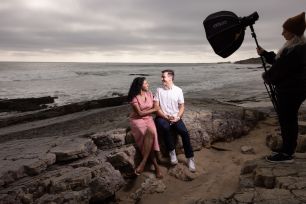
Expanded explanation of aperture
In photography, an aperture is the opening of a lens used to control the amount of light necessary to expose the sensor or film. In addition, the aperture is used creatively to control the compositional use of depth of field. A smaller (closed) aperture restricts light and increases the depth of field in a scene, whereas a larger (open) aperture allows for more light and decreases the depth of field within a scene.
This article is part of our Learn Photography guide.
→ See the complete Learn Photography guide
Aperture for exposure control
Aperture is one of the three pillars within the exposure triangle, shown below.

In our introduction, we simplified the exposure component of aperture to the following: larger (open) apertures allow more light to reach the sensor or film, while smaller (closed) apertures allow less. The pupil of your eye works in the same way. Your pupils naturally close to restrict light in bright environments and open (dilate) to allow for more light in dark conditions. Hold on to this simple truth as we discuss the details of aperture.
First, let’s talk about how aperture is measured and depicted. When we discussed ISO and shutter speed, number increments were naturally intuitive. A higher ISO speed represents higher sensor or film sensitivity, and thus more light, but also with the downside of decreased image detail. A higher shutter speed represents the shutter opening and closing faster, to freeze motion and also reduce the time for light to expose the sensor.
However, we see aperture measured in numbers such as “f/2” or “f/2.8.” It’s not exactly intuitive what these numbers mean. This is especially the case when we’re told that raising the aperture number — f/2.8 to f/5.6, for example — is actually decreasing the amount of light.

The reason for this is that aperture is measured as a fraction, similarly to shutter speed. The number (f/2, 2.8, 4, 5.6…) is the denominator of that fraction. Before we worry about what the “f/” actually means, let us first imagine the “f” being replaced by a 1:
- 1/2 is a bigger number than 1/4
- 1/4 is larger than 1/8
- 1/8 is larger than 1/16, and so forth…
From this, we can see and understand intuitively that as the aperture number (denominator) increases, the amount of light decreases. When we see the f-number displayed as fractions we can then understand that an increasing f-number is, in reality, a smaller number and thus denotes a smaller aperture opening. In fact, when all other settings are held constant, look at how each of the images below gets darker when the aperture or “f-number” increases.

In the examples above, we are showing “full-stop” increments, meaning each change in the aperture is yielding an image that is 2x (100%) brighter than the last. Thus when a photographer says “increase the exposure by one stop” they mean double the light; conversely “decrease the exposure by one stop” would mean cut the light in half. If you want to read more about the term “stop” or “f-stop,” take a look at this article. For now, let’s keep moving forward.
As we discussed earlier, shutter speed and ISO increments naturally make sense. They move in increments that are intuitive: double the number is double the light; half the number is half the light. What throws us off about aperture is the fact that the numbers don’t intuitively double or halve in the same way.
For example, we know that f/4 is darker than f/2 because f/2 is a larger fractional number. What’s tough to understand is that f/4 is not one stop darker than f/2 — it’s actually two stops darker. Why is this?
Below, you can see a common set of apertures from f/22 to f/2.8 on a classic manual-aperture lens. (Note: most modern lens apertures are controlled electronically by the camera body.)
 Nikon 24mm f/2.8 AI-S
The reason lies in the fact that a lens aperture is a circular opening, which is measured by its diameter. For now, simply understand that as a fractional measurement, f/2 offers twice the total aperture area for light to enter the lens compared to f/2.8 — thus the image is 1 stop brighter. f/2 offers four times the aperture area compared to f/4, so the image is 2 stops brighter.
Take a look at this graphic that represents lens aperture sizes in 1-stop increments.

Let’s now move on to discussing the creative use of aperture.
Aperture for creative control
There are three primary creative uses for aperture: depth of field, flare patterns, and sharpness.
Depth of field
The primary creative use of your lens’ aperture is for controlling what is called depth of field — how much of the image is in focus. To understand how this works, imagine that you have set the focus on your lens to be somewhere in the middle of a scene as shown below.

As you raise the f-number (stop down your lens aperture), both the foreground and the background will begin to come into focus. This is known as increasing the depth of field. As you lower the f-number (open the aperture), the foreground and background fall out of focus.
A portrait photographer may often use a wide or open aperture creatively to ensure that a background is out of focus. This brings attention to the subject rather than the background — known as subject isolation — as shown below.

Canon Rebel DSLR, Canon 50mm f/1.8
Conversely, a landscape photographer will often close or stop down the aperture to ensure everything is in focus, from the nearest subject to the horizon, as shown here.

F/16, ISO 100, 2-minute long exposure, 24-70mm @ 24mm, Nikon D750
Put another way: with a fast aperture like f/1.4 or f/2, your lens’ depth of field will be very shallow and your focus will appear selective. At f/11 or f/16, your lens’ focus may include everything from the nearest subject to the distant horizon.
Flare patterns and sunstar effects
One characteristic unique to each lens model, despite similar focal lengths, is how the aperture renders flare patterns and starburst effects.
The term “flare” describes any light source directly entering the lens. The look of that flare is largely a factor of the number of blades in the aperture’s design, in addition to the lens’ optical design. Many modern lenses are designed to minimize flare or render it aesthetically pleasing. Many older lenses have highly unique flare characteristics, although some produce flare patterns that simply distract from an image. Choosing a lens based on its flare character is usually something reserved for portrait photography and similar genres in which flare can be used as a creative tool. Landscape photographers, by contrast, may avoid any type of flare entirely.
You can also control the look of flare by opening or closing the aperture. In addition to increasing the depth of field, a small aperture opening will render incoming points of light as starburst patterns. The number of points on the star correlates to the number of blades in the aperture design, as shown below.


A wide-open aperture will cause flare light to appear more circular and to bloom around objects within the scene. Blooming is when light appears to wrap around an object, as shown below.
 Canon 5D mk3, Canon 35mm f/1.4 L mk2 | Aperture: f/2
The unique look of sunstars is largely influenced by the number of aperture blades and whether they use a rounded blade design. If you’re after sharp, pointy sunstars, older lenses (Nikon AI-S, Canon FD, Pentax M) tend to produce the most defined results.

Same focal length and aperture, different sunstar patterns — Nikon 35mm f/1.8 G ED vs. Nikon 35mm f/2 D
Optimal detail and sharpness
It would be inaccurate to assume that a lens’ aperture affects only exposure and depth of field, and that sharpness is a separate characteristic of the glass. Aperture affects sharpness too. Lenses are inherently less sharp at their fastest, widest apertures, and stopping down will increase the sharpness of in-focus portions of the image, even in areas that were already within the existing depth of field.

(Click to enlarge)
As a simple rule, a lens will typically be at or near its sharpest when stopped down 2–3 stops from its maximum aperture. An f/1.4 prime lens will become extremely sharp at f/2.8 or f/4. An f/2.8 zoom lens, such as a 70-200mm, will reach peak sharpness around f/5.6 or f/8. Be aware, however, that stopping down past roughly f/11 on most lenses introduces diffraction — a physics phenomenon that actually softens the image slightly even as depth of field continues to increase.
Thanks to modern design and optical coatings, most new lenses are very sharp even at their fastest aperture. Creatively, this allows a photographer to choose almost any aperture without severely compromising image quality.
That said, extreme sharpness isn’t always the right creative choice. Many portrait photographers intentionally shoot at their widest aperture because the slight softness at f/1.2 or f/1.4 is genuinely flattering on faces and skin. This is a subjective decision — shooting portraits at any aperture can yield strong results, and every photographer will find their own preferred approach through experimentation.
For a deeper look at how aperture interacts with shutter speed and ISO in real shooting situations, our Photography 101 Workshop covers the full exposure triangle with practical field exercises across portrait, landscape, and event photography.
Summary
Each camera setting plays an important role in the exposure triangle and has a unique creative purpose. Adjusting your aperture has various benefits and tradeoffs you can use to your advantage in any situation.
See the chart below for a quick summary of the exposure triangle:

Common aperture terms and jargon
Even after you understand the numbers, talking about aperture can feel confusing because photographers use many different terms for the same thing. Here’s a quick reference for the two directions you can dial your aperture:
Opening to a brighter exposure with your aperture may be referred to as:
- “Fast”
- “Wide”
- “Big”
- “Low” number (avoid this term — too confusing)
- “Shallow”
- “Bright”
Closing to a darker exposure with your aperture may be referred to as:
- “Slow”
- “Narrow”
- “Tight”
- “Small”
- “High” number (avoid this term — too confusing)
- “Stopped down”
- “Dark”
For more on building a complete foundation in camera settings, see our guides on shutter speed and ISO — along with the full Learn Photography guide that ties all three together.
Related Articles to Aperture Definition

ISO, Aperture & Shutter Speed | A Cheat Sheet For Beginners

Macro Flower Photography Tips

5 Tips on Shooting Sharp Images with a Wide-Open Aperture

Natural Light Portrait Tips | Use Hard Light to Shape the Body

Fall Children’s Portrait Photography Tutorial

Learn How to Photograph Lightning with These 7 Essential Tips

6 Must-Have Lenses For Wedding Photography

5 Milk Bath Boudoir Photography Tips

How to Become a Sports Photographer

How to Get Correct Exposures Without a Light Meter

Creative Photography Ideas | How to Shoot “Water Hats” on the Cheap!